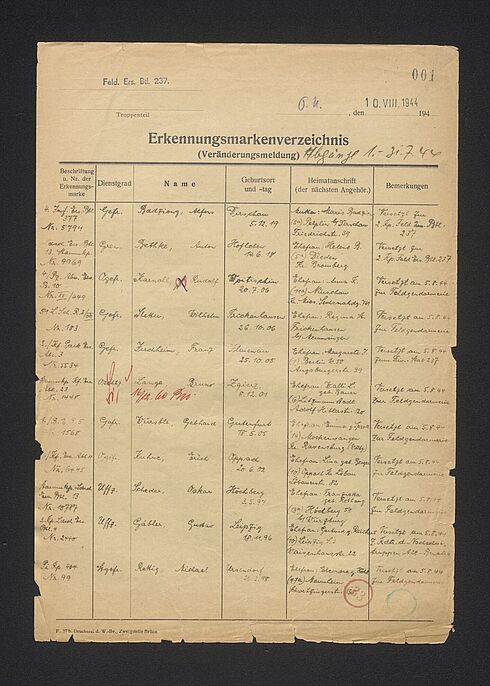
In the Wehrmacht’s personnel administration system, identity tag registers were used to regularly document the movement of personnel between military units. All units recorded personnel changes in data lists and change reports. In principle, they make it possible to identify all persons who belonged to a unit during its existence. As a result of war, however, personnel administration requirements were not always implemented and consequently there are gaps in the documentation.
After being mobilised or conscripted into their first unit, every member of the Wehrmacht received an identity tag. The release was noted in the data lists with the corresponding personnel details. If a soldier had already received a tag from another unit, the previous tag label was adopted. This list contained the stamp inscription, rank, name, place and date of birth and comments, as well as the home address of a next of kin for notification in the event of death. This information was also recorded in the change reports.
The identity tag was the military personnel administration’s most important identification document. Soldiers only received a new tag if they had lost the original or had re-entered military service after a discharge.
The PA department holds nearly 100 million person-related reports on members of the Wehrmacht conscripted between 1939 and 1945. The records, however, are not complete. There are also isolated registers of identity tags from the Waffen-SS and police units. As a rule, the personnel records are sorted by unit and can be searched for.
When using the identity tag registers, the following citation should be used: BArch, B 563/[archive number].