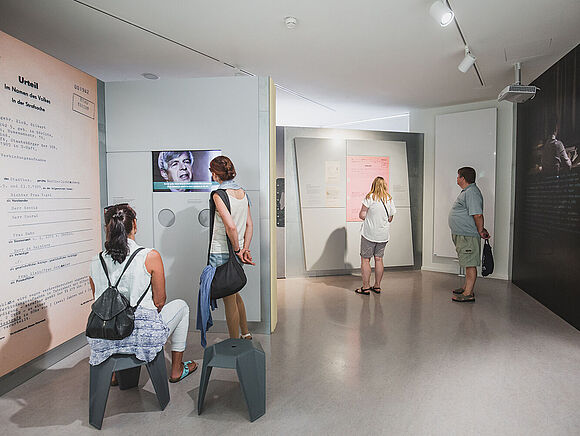
A group of Pupils in the Stasi Archive in Berlin.

A group of Pupils, Source: BStU

School Education

The Stasi Records Archive provides printed material, audio and video recordings as well as downloads for project days and teaching lessons. The material includes teaching guides with suggestions for lessons, work material for pupils as well as an educational film.

Jump to content

What was the Stasi?

The term "Stasi" is an abbreviation for "Staatssicherheit" (state security). That is what the East Germans called the Ministry for State Security, which was officially abbreviated "MfS". The Stasi had two functions: It worked as both a secret service and a secret police. Many countries have a secret service agency. They are responsible for detecting threats to the country from abroad. Secret police usually only exist in dictatorships. They have the task of controlling their own citizens and eliminating any danger to the ruling regime. They are accountable only to the rulers and circumvent the laws that normal police must obey.
Learning at an Authentic Site

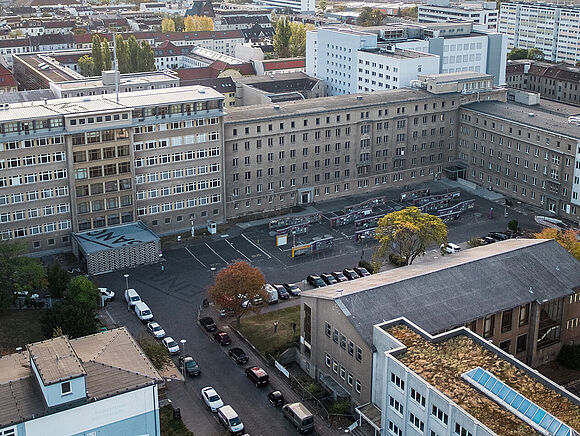
Former Stasi Headquarter in Berlin

We offer you the special opportunity to learn about the history of the Stasi at an authentic site: on the former grounds of the Ministry for State Security. "Haus 1" forms the centre of the complex. This is where Erich Mielke, the Minister of State Security, had his office until November 1989. It was from here that the Stasi, as "shield and sword of the party," defended the SED ruling party’s claim to total control over the people in the GDR.

The education staff of the Stasi Records Archive works above Mielke’s former office in "Haus 1". Seminar classrooms are located here. After receiving an introduction into the subject of the GDR State Security, classes can visit "Haus 1," and take a tour of the archives. Or explore the grounds of the former Stasi headquarters.


Stasi Museum

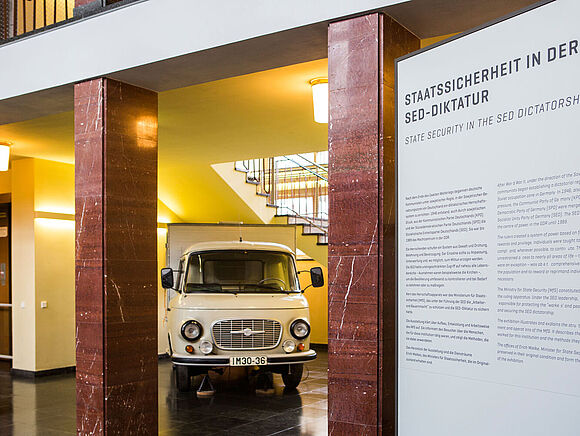
After civil rights activists took over the Stasi headquarters in January 1990, the association "ASTAK e.V." established "Haus 1" as a research and memorial site on 7 November 1990. The former headquarters of the GDR secret police remain open to the public. Mielke’s office, the work areas of his closest staff, a large conference room and the casino are today a museum at an authentic site.

"Haus 1" was reopened in January 2012 following extensive renovations. In addition to the original rooms of the minister, two other levels with the exhibitions created by ASTAK e.V. and the Stasi Records Archive are also open to visitors.

Exhibition at the Stasi Museum

Exhibition: "Access to Secrecy"

Exhibition "Access to Secrecy"

An oversized „walk-in file“, an original index card paternoster, a sculpture of files – the exhibition shows the collection of information violating human rights and the effect the GDR secret police had on people’s lives.

Over four floors the exhibition illustrates the Stasi Records Archive‘s current tasks and leads back in time to when the Secret Police created the files.

Contact

Education Team

Normannenstraße 20 "Haus 1"
10365 Berlin

Phone: +49 30 18 665-6757
Email: bildung.stasiunterlagenarchiv@bundesarchiv.de