Symbolbild einer Trägerkarawane. Ein direkter Zusammenhang mit Kulturgutverlagerungen ist nicht belegt.

Symbolic image of a caravan of porters. No direct connection to the displacement of cultural property has been established, Source: Bundesarchiv, Bild 146-1984-041-09 / o. Ang.

Sources on the Displacement of Cultural Property in Colonial Context (1884–1918)

Jump to content

Introductory information 

When the governing coalition 2018–21 announced its commitment to the „Aufarbeitung der Provenienzen von Kulturgut aus kolonialem Erbe“ (reappraisal of the provenance of cultural property from colonial heritage) (2018) and the federal, state, and local authorities negotiated an agreement in the „Ersten Eckpunkten zum Umgang mit Sammlungsgut aus kolonialen Kontexten“ (framework principles for the care of collections from colonial contexts) (2019) the political course was set for investigating the provenance of collected goods from colonial contexts. Based on this, “Gemeinsame Leitlinien zum Umgang mit Kulturgütern und menschlichen Überresten aus kolonialen Kontexten“ (Common guidelines for the care of collections and human remains from colonial contexts) were agreed upon in October 2025.

The archival holdings of the Federal Archives from the period of German colonialism contain important sources for postcolonial provenance research that can provide information on the origin of objects acquired under colonial conditions. Research into the colonial structures reflected in the authentic sources of the Federal Archives is particularly important in this context. Taken together, they help us better understand the history of displaced cultural property between 1884 and 1918.

The colonial holdings preserved in the Federal Archives generally reflect the perspectives of German colonial agents. Therefor a critical assessment of these sources is essential. We ask that you also take note of the Hinweise zur spezifischen Sprache kolonialer Quellen (information regarding the specific language used in colonial sources). .
Accessing information 

Users can research documents from colonial times that are preserved in the Federal Archives by using the catalogue data provided in invenio, the Federal Archives’ search tool. The most important archival materials relating to colonial history have been digitised and are accessible via invenio (including a download function). Please also take note of the options for Digitalisation on demand.

Digitally available image material (mainly photos and posters) can be accessed in the Digital Picture Archive. Film material can be searched in the Digital Reading Room.

The original records from the colonial period are kept at various locations of the Federal Archives. Government civil documents, personal paper collections, and films are kept in Berlin-Lichterfelde. Military records and military-related personal paper collections are preserved in Freiburg. Personal paper collections and numerous photos are also found in Koblenz.

Access to and use of colonial records is subject to the provisions of the Federal Archives Act (BArchG).

Research strategies 

As a general rule, the preserved records from the colonial period do not contain large file collections, list compilations, or card indexes relating to displaced cultural property. Specific research strategies are therefore advisable.

In the context of postcolonial provenance research, it is important to assess the acquisition contexts across different objects. This can be done by searching individual persons involved, scientific expeditions, so-called “punitive expeditions” and other violent undertakings, as well as geographical terms. This may lead to a list of or references to individual objects, for example in documents relating to the financing of expeditions.

A good place to start research is the geographical overview of colonial holdings in the Federal Archives, which assigns the available holdings to individual colonies.

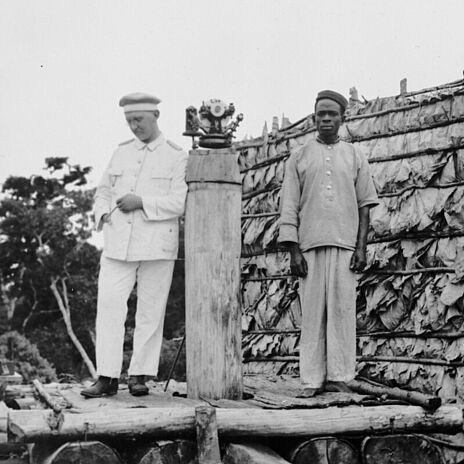
Ein weißer und ein schwarzer Mann bei der Grenzvermessung der Süd- und Südostgrenze von Kamerun gegen das französische Kongogebiet

Geographical access to colonial history holdings 

An overview of the holdings on German colonial history, organised according to the German colonies and ‘protectorates’ in Africa, the Pacific Ocean and China is available here.

more

Within a collection, structured or navigational searches in invenio may in some cases lead to relevant documents. Synonyms, terms or spellings typical of a particular period, and old or Germanised place names (such as Schutzgebiete (protectorates) instead of Kolonien (colonies), Jaunde instead of Yaoundé, Klein Popo instead of Anecho or Aneho) can also be considered as search terms. Entering personal names, place names or subject terms in the search box will often fail to deliver the desired results. It is therefore advisable to conduct a structured or navigational search in invenio. To do this, search the „Klassifikation“ (structure) of a collection (similar to the table of contents of a scientific paper) for overarching topics related to your search topic, such as „Forschungsreisende in Togo“ (explorers in Togo) or “Aufstände in Deutsch Neuguinea“ (uprisings in German New Guinea). Reviewing the files that appear there may lead to relevant results.

Please note that there is generally less documentation available for regions that were only briefly under German colonial rule. (The rule of thumb is: the further inland, the shorter the period of German rule, e.g., Rwanda). In addition, the records contain gaps, particularly due to events related to World War I and II (for example, the destruction of most of the “Schutztruppen” (colonial troops) records).

Many documents relating to colonial history are written in an old German writing style (Kurrent or Fraktur). The „Kurrent-Schreibmaschine“/Kurrent typwriter can help you decipher these old texts.

Selection of relevant archival holdings

The sources from the German Empire (1871-1918) preserved in the Federal Archives contain a wealth of authentic sources on the German colonial period from 1884 onwards, which can be used for provenance research on cultural property from colonial contexts. These include the holdings of government agencies, in particular the Reichskolonialamt (Reich Colonial Office), as well as the holdings of non-governmental protagonists. Colonial records, however, do not generally contain large collections of documents with explicit reference to displaced or unlawfully seized cultural property. It is therefore necessary to conduct detailed research in each specific case.

One should not expect to find documents from missionary societies, private companies (trade, plantations), or museums in the Federal Archives, with the exception of correspondences between institution representatives and government agencies.

The following list of holdings is intended as an example and is not exhaustive. When conducting research in invenio, please consult the sometimes very detailed information on the respective holdings, which addresses the collection’s history and its main content focus.

Further information