Accessing information
The relevant GDR holdings of the Federal Archives can be searched using the Federal Archives’ research tool invenio. They fall under different areas of responsibility and are stored at different locations within the Federal Archives. The majority of records are kept in Berlin-Lichterfelde, where they are accessible to the public. The documents of the Parties and Mass Organisations, as well as personal paper collections, are also located in Berlin-Lichterfelde and administered by the SAPMO (Foundation Archive of the Parties and Mass Organisations of the GDR in the Federal Archives). Documents of the National People’s Army are kept in the Military Archive of the Federal Archives in Freiburg. Image collections, films and posters are stored in Berlin-Lichterfelde. Digitally available image material can be accessed in the Digital Picture Archives. Material can be searched in the Digital Reading Room. Please also note the options for digitization on demand.
Access to and use of the GDR holdings are subject to the provisions of the Bundesarchivgesetzes - BArchG (Federal Archives Act).
The Federal Archives’ general data protection period of 30 years has expired for the GDR holdings and never applied to SAPMO documents. However, because GDR files often contain personal data, large quantities are subject to restricted access. In cases of justified interest, the retention period may be shortened under certain conditions.
Research strategies
The Federal Archives are responsible for storing documents of archival value from the highest level of government in the Federal Republic of Germany, and since 1990, also from the corresponding GDR archives. Due to the structure of state and society, both in the Soviet Occupation Zone and in the GDR, this highest level of government includes not only ministries and directly subordinate authorities, but also political parties and mass societal organisations. Documents and materials from the German authorities of the SBZ (Soviet Occupation Zone) have been preserved as part of the records of the GDR institutions that emerged from them. In cooperation with archives in the Russian Federation, large parts of the files of the Sowjetischen Militäradministration in Deutschland - SMAD (Soviet Military Administration in Germany) are also available in the Federal Archives for academic research. Archival records on the investigation and relocation of cultural property in the SMAD files are accessible via a finding aid available in Berlin-Lichterfelde (subject-based inventory on the cultural policy of the SMAD 1945-1949). They contain, among other things, orders, notes and reports on hidden cultural assets tracked down by the Soviet occupying army, including treasures in Schwerin and near Leipzig, and ‘trophies’ – cultural assets confiscated by the German occupying power on Soviet territory during the Second World War. The language of the files is Russian.
Some functions that were organised centrally in the GDR no longer fall within the remit of today’s state administration. These include the security of art transports by the GDR Office for the Protection of Cultural Property at the Ministry of Culture, as well as the activities of the GDR Centre for Art Exhibitions. For guidance, we recommend reviewing the GDR holdings of the Federal Archives in the invenio research application (navigational search).
The Federal Archives also holds records of “centrally managed” state-owned enterprises, i.e., companies assigned to the highest level of government, including, for example, the GDR state art trade Agency and foreign trade companies. The Kunst und Antiquitäten GmbH (KuA) is especially interesting for provenance research. Records of other economic enterprises are preserved in state and municipal archives, in economic archives, or with the companies or their successors.
In recent archival descriptions, references are frequently made to groups of cultural assets found in the files, e.g., toys, furniture, musical instruments, paintings, household goods, etc. However, this does not mean that references to other cultural assets do not exist in the respective files. In all cases, a significant research effort will be required.
Paintings
Regarding paintings, the chances of a successful search are quite good, given the availability of information on the signature, title, subject, size, and painting technique. However, pictures are rarely described in detail in the files. Even for well-known works, the titles used in art history publications are often not mentioned in the files. This is the case, for example, with Klimt’s portrait of Marie Henneberg in a file of the Cultural Property Protection Commission. In the file, the painting is referred to as “Lady with a Bouquet of Violets” (and, as part of a personal paper collection does not yet find mention in the ‘content notes’ in invenio).
Graphic art
The KuA began exporting graphic art in the 1970s. Due to the limited value of many single pieces, individual works have generally not been included in the “content notes” section in invenio; in the case of collections, often only the artist’s name is included. The State Art Trade Agency sold prints on a large scale through its galleries. Here, all traded artists were included by name in the “content notes” in invenio.
Books
References to antiquarian books can be found in the holdings of the Federal Archives primarily in the KuA documents beginning in 1987 (transfer of antiquarian Johannes Wend from the Central Antiquarian Bookshop of the GDR to the KuA, establishment of an aggressive purchasing department based in Leipzig). However, in relation to the quantity of books exported, the impact on the preserved files is minimal. There is also no direct evidence of any old collection libraries being forcibly exported by the KuA in the late 1980s, as has been reported in the Literatur.
Furniture and porcelain
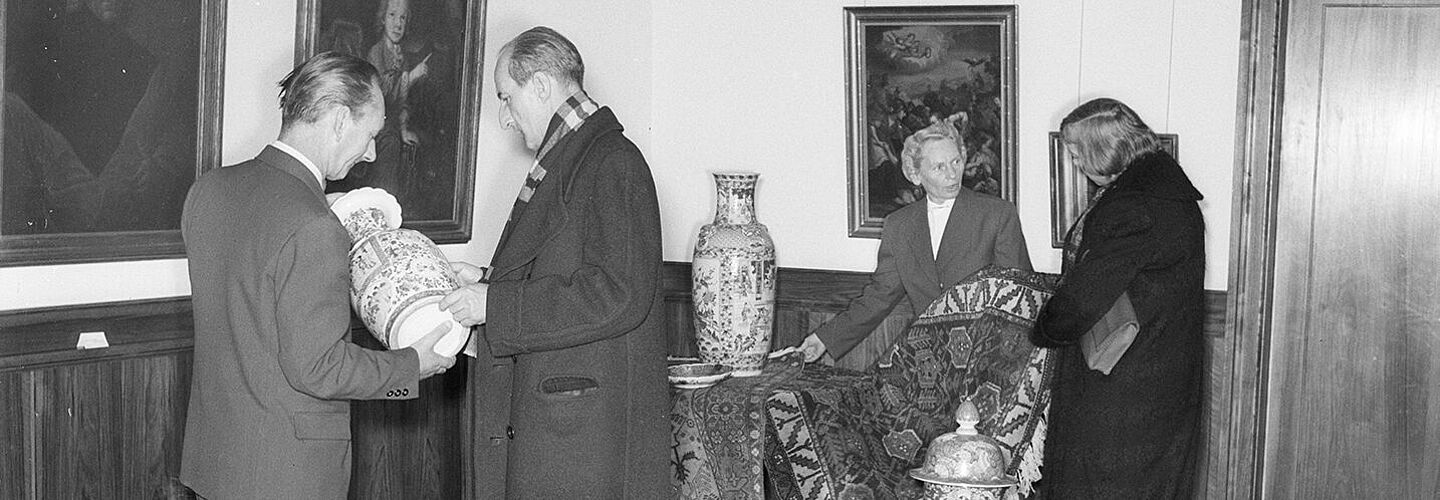
Furniture and porcelain were among the preferred product groups for KuA exports. Individual, particularly valuable pieces, are listed in the “content notes” in invenio. However, descriptions such as “baroque secretary, three-piece, walnut veneer” can only be used to identify an object in combination with “sticker numbers”.
Selection of relevant archival holdings
The sources and references listed below provide an overview of relevant SBZ/GDR archive material from 1945 to 1990. This overview is not exhaustive.