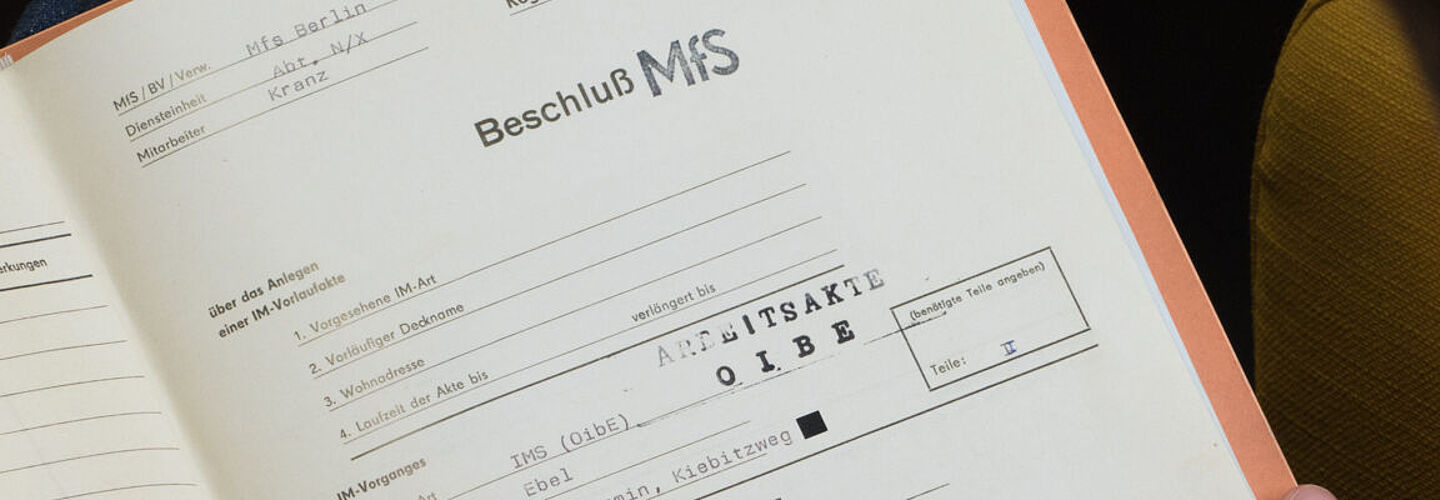
Blick in eine Akte. Sichtbar ist der Beschluss zur Anlage eines Vorgangs zu einem verdeckten Stasi-Offizier

A peek into a Stasi file, Source: BArch

Sources in the Federal Archives – Stasi Records Archive

Jump to content

Introductory information

Due to the special nature of the records of a secret police force, access to the holdings in the Federal Archives – Stasi Records Archive (StUA), inspection of documents and the issuance of duplicates are restricted, primarily to protect the personal rights of the individuals named therein. Access and use are subject to the special provisions of the Stasi Records Act (StUG).

Researchers from universities, colleges and research institutions in Germany and abroad are granted access. Private research requests, requests for use by journalists and political education institutions are also possible. The user must always submit an application with their request to access the holdings.

Researchers working at universities, other research institutions, or for the State Commissioners for the Reappraisal of the SED Dictatorship and the Consequences of the Communist Dictatorship can obtain access to non-anonymised documents, should this be necessary for scientific research. To obtain this extended right of access, a formal obligation under the Obligation Act is required.

Users can conduct initial research in invenio – subject to restrictions under the StUG. However, the staff of the StUA conduct the comprehensive subject-matter and name-related research and prepare the documents for inspection and release, in close consultation with the users. It is therefore extremely important to define and describe the topic as precisely as possible. The State Security Service mainly kept records on individuals, but the documents can also be searched by subject. For searches on individuals, the exact date of birth and details of first and last names, including maiden and married names, are always required. For searches on subjects, details of events, companies and other relevant information should be as comprehensive as possible. With their expertise and years of experience, the StUA staff are available to assist you with any questions you may have, including issues that may arise during the research process. They are also happy to provide personal consultations.

After the research results have been evaluated, relevant archive material will be anonymised if necessary and made available for you to view (either digitally or in analogue form, depending on your preference) in the reading rooms of the respective locations. Copies of these documents can also be issued without prior inspection.

Research strategies

In accordance with Sections 1 and 2 of the StUG, the StUA is responsible for recording, storing, indexing, using and disseminating the documents of the State Security Service of the GDR (1950–1989). The records include those of the Ministry for State Security (MfS) and the fifteen District Administrations for State Security (BVfS), as well as the subordinate county offices (KD) and facility offices. The holdings also include documents transferred to the State Security Service from the Criminal Investigation Department, the courts, and the public prosecutor’s offices of the GDR.

To investigate a specific question within the framework of provenance research, such as the whereabouts of a private art collection, it can be useful to adopt a structured, person- or theme-related research approach. These different approaches are also a consequence of how the State Security Service documents are organised. These are divided into two record areas: One group consists of files that were already closed and archived by the Stasi (MfS terminology: „archived files”). These were administered by Abteilung XII of the Ministry or the District Administrations for State Security. In most cases, access to these files is person-specific, using the finding aids created by the State Security Service. They are currently being indexed by subject matter as well. The other group of records consists of files from the offices of the employees, the so-called “service unit records”. Since these documents lacked both a table of contents and finding aids, the staff initially focused its indexing efforts on this group of State Security Service records.

Selection of relevant archive holdings

The following is a brief description of the sources preserved in the StUA for provenance research and for cultural property confiscation, organised according to the three research approaches mentioned above.

The overview is not exhaustive. The records of the individual organisational units of the MfS, BVfS and KD are stored below the specified classification point of the holdings MFS 1 to MFS 16. The classification points serve to subdivide the aforementioned holdings.

Structured research

Within the State Security Service, areas of responsibility for secret police and intelligence tasks, as well as for internal operations, were defined. However, due to frequent structural changes, shifting priorities, and the State Security Service’s specific working methods, these defined responsibilities cannot always be clearly distinguished from one another. Nevertheless, conducting structured research within the relevant areas of the Ministry and the District Administrations for State Security remains a promising approach.

Person-related searches

Person-related searches in the documents archived by the MfS and the finding aids created for them are promising. In particular, the central Persons Index F 16 and the corresponding Case Index F 22, both with identical registration numbers, lead to the archived files. References to persons can also be found in the „service unit records“. This is based on the provision in Section 3 (1) of the StUG, according to which „Each individual shall have the right to enquire of the Federal Archives whether records exist which contain personal data about him.“ In implementing this provision, all relevant persons are recorded in the subject-based index.

A search for a person requires identifying the persons involved in the transfer or withdrawal of cultural property. These could include, for example, employees working in the areas of MfAH, KoKo, KuA, customs, and the Staatliche Kunsthandel - SKH (State Art Trade Agency), those affected by the withdrawal, as well as museum directors, experts, and antique dealers. The research is conducted based on personal information provided to StUA employees.

Thematic research

The scope of information gathered by the State Security Service in various observation, surveillance, and investigation contexts led to findings about the existence of valuable private art and antique collections and private assets. The information collected was passed on to the relevant structural units as necessary, but was also recorded in writing in the information-gathering area. As a result, a cross-sectional search of the entire holding may be beneficial. However, the procurement of foreign currency was not limited to categorised art and cultural property; it was directed at all valuables and assets in „public“ and private ownership. The spectrum of confiscated objects includes archaeological finds and archival materials, books, glass and crystalware, historical weapons and militaria, medals, furniture, coins, musical instruments, porcelain, jewellery, toys, and documents. However, few detailed overviews or descriptions of the confiscated objects are preserved in the StUA holdings. Moreover, there are discrepancies in the titles or descriptions of works of art. A search for higher-level categories of cultural property or groups of goods is therefore more promising than a search for a specific object.

The invenio archive database can also be used for a subject-related research. Selected keywords can be used to search for relevant documents in both the central and regional archives of the State Security Service.

Cover Blum Kulturgutverluste

In Search of Lost Cultural Property: A Special Inventory of Stasi Files

As part of provenance research into the confiscation of cultural property in the GDR, this special inventory, commissioned and compiled in collaboration with the German Lost Art Foundation in Magdeburg (DZK), provides an overview of the relevant documents of the GDR State Security Service relating to the transfer and loss of cultural property. It systematically describes the surviving sources, provides comprehensive information on the concept of cultural property and, based on the state of indexing achieved by 2019, references relevant individual archival records.

more

Additional information